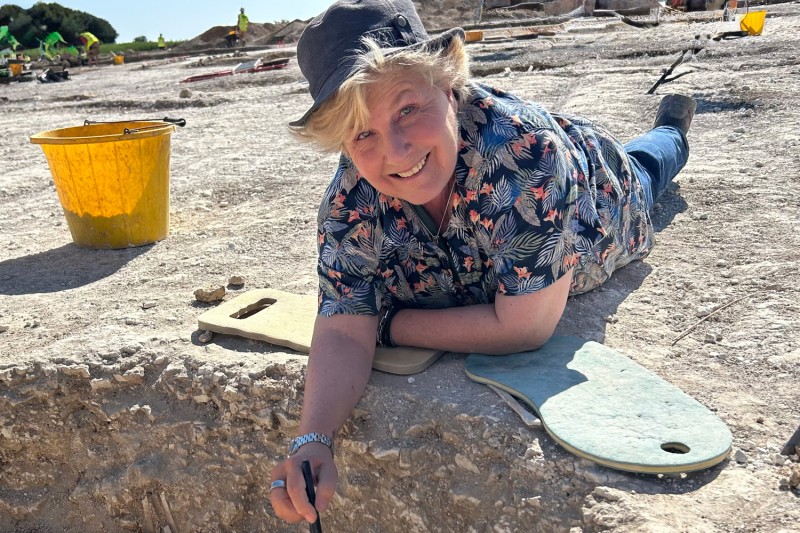
Bournemouth University’s (BU) Principal Academic in Prehistoric and Roman Archaeology, Dr Miles Russell welcomed broadcaster Sandi Toksvig to an archaeological excavation in Dorset to investigate a 2,000-year-old Iron Age settlement as part of a new Channel 4 television series called ‘Sandi Toksvig’s Hidden Wonders’.
In the first episode Sandi and Miles uncover the domestic dwellings and cemetery of an Iron Age tribe called the Durotriges, who lived in rural Dorset before the Romans. Using the evidence they unearthed, they learnt more about how the tribe lived and died, what rituals they might have used and the kinds of tools and implements that they made.
As BU students and volunteers were excavating the site they discovered the skeleton of a teenage girl buried face down in a pit. Their analysis suggested that she could have been murdered as a human sacrifice. They also found that she suffered damage to the arms and upper torso, possibly acts of violence prior to her death. Burying someone face down wasn’t usual practice at the time and the deceased were placed with care in graves, something which also suggests that she could have been a sacrifice.
More than 40 years after graduating from a degree in Archaeology and Anthropology from the University of Cambridge, Sandi has explored four sites of special interest in the brand-new series to unearth the secrets of Britain’s past.
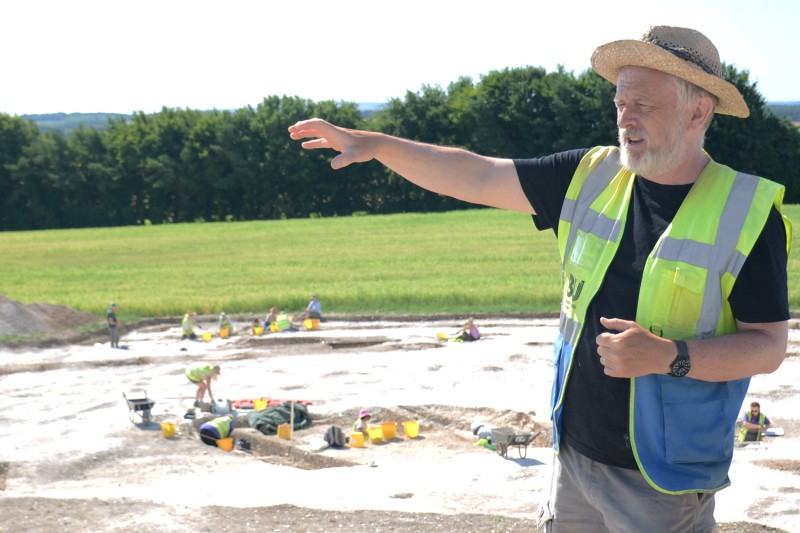
Miles who was working with Sandi during filming of the episode said: “The team were particularly shocked to hear that this could have been a human sacrifice, but it was obvious from Sandi’s own interest in Archaeology that she was deeply moved by what had been uncovered.”
“Sandi was also very interested in the artefacts discovered by students in the pits and with the deceased, such as bronze brooches, a bronze bangle and a bone comb. The finds were often in a Roman style, demonstrating a blend between Roman and traditional Iron Age customs, helping us to build up a picture of the how these people lived and died 2,000 years ago.”
Ongoing work on the DNA and isotopes recorded for the burials is suggesting that the Iron Age Durotriges tribe were a matriarchal society, in which women owned the land, the men deriving from a variety of different locations around Britain and NW Europe. DNA evidence further indicate that the tribal lineage can be traced back to a single woman. This evidence points to communities being centred around the mothers of families and suggests that men were invited to live with women, not the other way round.
Miles continues: “It marks the first time that evidence of matrilineal communities have been documented in western European prehistory.”
Sandi Toksvig’s Hidden Wonders airs on More4 from Tuesday 4th November at 9pm.