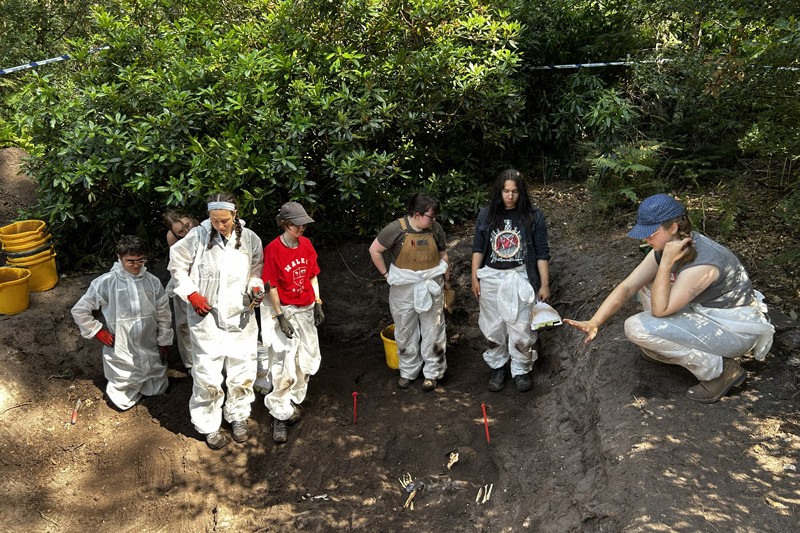
Over the summer, Bournemouth University delivered a mass grave simulation giving students hands-on, ethically led experience in forensic recovery and documentation.
Students from the Forensic and Archaeology degree programmes took part in a supervised mass grave simulation at Dorset. The exercise mirrored disaster victim identification (DVI) workflows—from initial scene assessment through to recovery, recording and transfer to lab—within a safe training environment.
"Mass graves are encountered following conflicts, disasters and human rights violations worldwide. Rigorous training helps protect human dignity, supports the search for the missing, and strengthens evidence standards that enable identification, repatriation and accountability—contributing to humanitarian response and the rule of law, explained Dr Samuel Rennie, Senior Lecturer in Forensic Investigation at BU.
Designed and delivered by Dr Rennie and Dr Melie Le Roy (Lecturer in Biological Anthropology) and funded by the Higher Education Innovation Fund (HEIF), the simulation emphasised dignity, evidence integrity and teamwork across forensic archaeology and anthropology.
The skills the students developed included:
- Scene security, risk assessment and task briefing
- Grid set-up and how to carefully dig through layers and keep detailed records of where each item is found.
- Studying how the bodies have been affected by environment or other factors, and gently recovering mixed human remains
- Systematic documentation: context sheets, scaled photography, evidence marking, and 3D/total-station mapping
- Packaging, labelling and chain-of-custody procedures
- Trauma-informed, ethically grounded practice and team communication
“Exercises like this translate classroom knowledge into confident, professional practice,” said Dr Rennie. “Students gain the precision and care required for complex investigations while working within clear ethical frameworks.
"Thank you to all staff who were involved and facilitated the scenario and to HEIF for supporting high-impact, experience-based learning that prepares graduates for complex, real-world contexts."