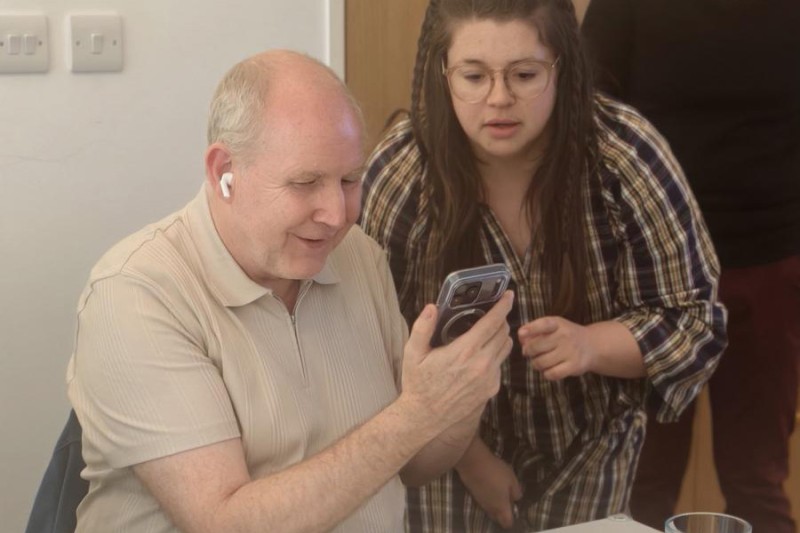
 Participant Paul learning social media editing software
Bournemouth University has held its latest workshop to help visually impaired people build the digitals skills to help them feel part of the online world and improve their wellbeing.
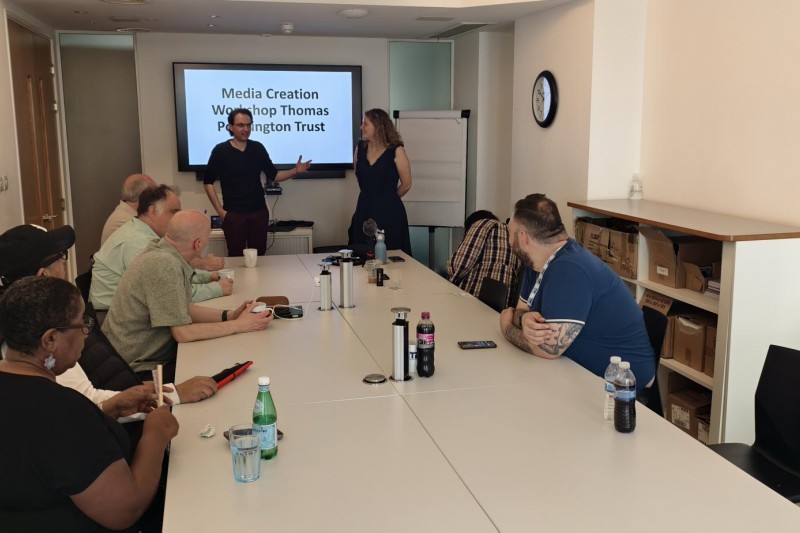
The most recent workshop took place with the Thomas Pocklington Trust in Central London on 22 May, where digital trainers helped participants to use tools such as video editing software, sound recording equipment and social media apps. This follows previous sessions that were held in Dorset with Dorset Blind Association and in Croydon with the charity Croydon Vision.
Blind and visually impaired people are often excluded from full participation in society. They are twice as likely to be negatively affected by equal rights than sighted people, according to the RNIB. Everyday barriers that contribute to this exclusion have significant, negative impacts on their wellbeing.
Dr Catalin Brylla, Principal Academic in Film and Television at Bournemouth University who leads the project said: “So many aspects of our social and professional lives now happens online, and it’s vital that blind people are not left behind as the digital world continues to grow. Whilst social media still largely excludes people with visual impairments, the encouraging reality is that some technology already exists to make online platforms and media creation more accessible — everything we use in these workshops is publicly available and already in people’s hands.
"A big part of our work is training blind people how to use existing tools, features and platforms - including AI - that can help them participate more confidently and independently online."
Dr Brylla has been delivering the workshops alongside Professor Anica Zeyen of Royal Holloway University of London, whose research centres around inclusion in society for people with disabilities.
Bradley, who attended the most recent workshop said, “This gave me more insight into editing and production of videos, which will help me in making my own podcast in the future. I have a rare eye-condition and a well-edited podcast can help me to spread awareness about the condition more effectively.”Another participant, Paul, added, “I'm sure that editing video and creating content is doable as a blind person, and this introductory session gave me a taster on how to do that and make content in the future.”
Dr Beverley Duguid, Research and Insights Manager at Thomas Pocklington Trust said, “When I was first introduced to the project I was immediately struck by the opportunity for positive engagement with the blind and partially sighted community. It was great seeing everyone so enthusiastic and engaged. We look forward to future collaboration.”
The aim of the project is to run the workshops in other areas of the UK and to roll out the training, so that other charities can help their local communities to access the same social media opportunities as sighted people.