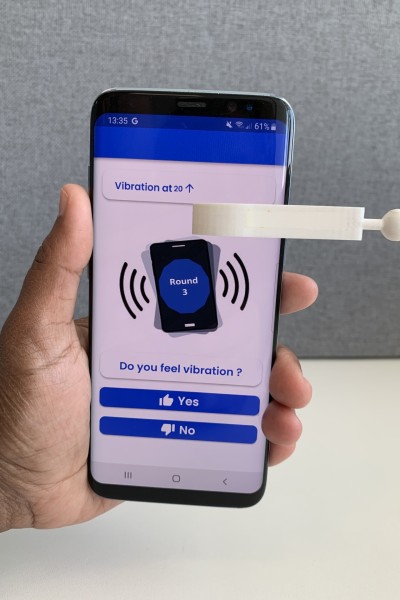
‘NERVE’ is a simple-to-use smart phone app with a low-cost, reuseable probe that detects Peripheral Neuropathy (PN) earlier than devices currently available. We are seeking partners to license and bring this patented technology to international markets to improve well-being of people living with diabetes.
Key benefits:
- Detects onset of PN earlier than other diagnostic equipment currently in use worldwide
- Designed with patient input, the self-calibrating, standardised test procedure is quick and easy to use in clinic or at home (patient/carer) delivering cost-effective PN point-of-care testing
- Interoperability – can track disease progression via patient data transferred to electronic patient record system from mobile phone
Diabetes and Peripheral Neuropathy - the cost of diabetic foot disease
The risk of foot problems is increased by diabetic PN (nerve damage or degeneration) and/or peripheral arterial disease (poor blood supply due to diseased blood vessels in the legs).
Foot problems in diabetics have a significant financial impact on primary care, community care, outpatient costs, increased bed occupancy and prolonged hospital stays.
Around 10% of diabetics will have a foot ulcer, with ulcers preceding more than 80 per cent of amputations in diabetics. Mortality rate is high at around 50% within five years of developing an ulcer, and up to 70 per cent within five years of amputation.
Solving unmet healthcare needs
The NERVE device has been developed by a collaborative team of research scientists from Bournemouth University and consultants from University Hospitals Dorset, funded by the i4i NIHR programme. The device development process has been quality managed by BU’s Research, Development and Support, which is ISO registered, and provides regulatory support for healthcare-related research, development and commercialisation activities.
It is the only device to measure below 25VPT at home (patient/carer) or in the clinic (healthcare professional) and offer standardised monitoring for earlier detection of PN before irreversible damage occurs.
The app features a simple, user-friendly interface with built-in training to ensure ease of use. It is compatible with both Android and iPhone devices (iPhone 8 and above).
A unique self-calibrating mechanism ensures consistent and accurate results across all supported phone models.
The device includes a detachable, low-cost probe designed for precise vibration testing. Additionally, the app supports interoperability through HL-7/FHIR standards, allowing seamless integration with healthcare systems.
Clinical trial and findings
This study was designed as a single-centre validation study aimed at evaluating diagnostic tools for individuals with diabetes.
A total of 311 participants diagnosed with diabetes were enrolled in the study. Two devices, the NERVE and the Neurothesiometer (the accepted gold standard for PN testing), were used to assess vibration perception threshold (VPT) - a key indicator in detecting diabetic PN.
VPT readings were collected from participants during two separate visits to ensure consistency and reliability of the measurements. Additionally, qualitative feedback was gathered from patients, their carers, and healthcare professionals (HCPs) to assess the usability, comfort, and overall experience with the devices.
This comprehensive approach provided both quantitative and qualitative data to validate the effectiveness of the tools.
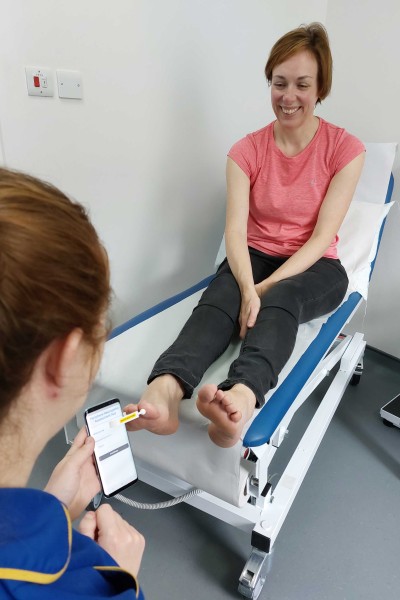 A healthcare professional using the NERVE device with a patient
The results demonstrated that the NERVE device produced VPT readings equivalent to those of the Neurothesiometer, while both devices showed similar repeatability. This supports the feasibility and acceptability of integrating the NERVE device into both clinical practice and home-based settings.
The usability analysis found that patients experienced improved usability and comfort with the device over time, indicating a positive learning curve.
Healthcare professionals' feedback after using the NERVE device was that it was easy to use as the standard Neurothesiometer. They also observed incremental improvements in handling and efficiency with continued use, reflecting growing familiarity and confidence with the device.
For further information around the findings of the clinical trial, please get in touch.
Implications for clinical practice
The NERVE device offers significant benefits for clinical practice. Its capability to support remote monitoring allows patients to manage their condition from home, improving access to care and reducing the need for frequent clinic visits. This, in turn, helps lower the clinical workload by minimizing the time healthcare providers spend on routine neuropathy screenings.
Most importantly, the device enhances early detection and intervention for PN below 25VPT, where PN is thought to have already occurred, enabling timely treatment that can prevent disease progression and complications.
Improved health outcomes
The NERVE device is the only solution designed to support routine PN testing and monitoring for people with diabetes, whether in outreach clinics or at home. This enables earlier detection of sensation loss and timely treatment interventions.
Its user-friendly design requires minimal training, significantly reducing the time healthcare providers need to spend on PN identification and monitoring within the diabetes care pathway.
Additionally, the device promotes patient engagement and education, empowering individuals to take an active role in managing their diabetes. Beyond diabetes care, NERVE also introduces innovative monitoring solutions for patients undergoing potentially neurotoxic chemotherapy.
With low barriers for provider adoption and care pathway integration, preliminary health economics research indicates that implementing NERVE could lead to substantial healthcare cost savings across global diabetes management systems.
The NERVE device also has strong potential for broader adoption in primary care settings, making routine PN screening more accessible to larger patient population. Additionally, integrating the device with digital health ecosystems could streamline data sharing and care coordination, further improving patient outcomes and supporting more personalized diabetes management.