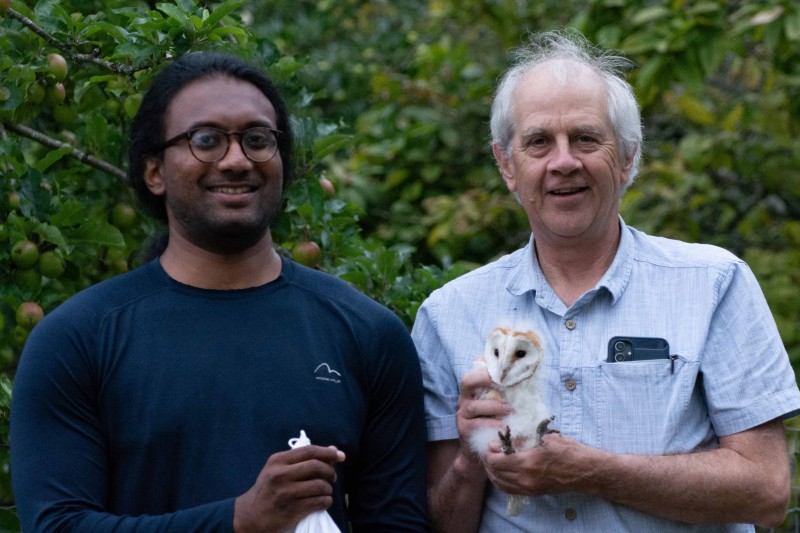
 BU's Kavisha Jayathunge (left) and Brian Cresswell
A PhD student at Bournemouth University is developing an AI model to help with the conservation of barn owls in Dorset.
Kavisha Jayathunge is working with Brian Cresswell, a biologist-turned-electronics engineer who uses technology to support ornithological research, especially barn owls and nightjars.
“We're using AI to count baby barn owls by sound instead of disturbing them in their nests with video cameras,” Kavisha said. “This helps reduce stress on the birds and could give us data from natural nest sites, which are often inaccessible for monitoring, not just the artificial nestboxes where most of the data we currently have comes from,” he added.
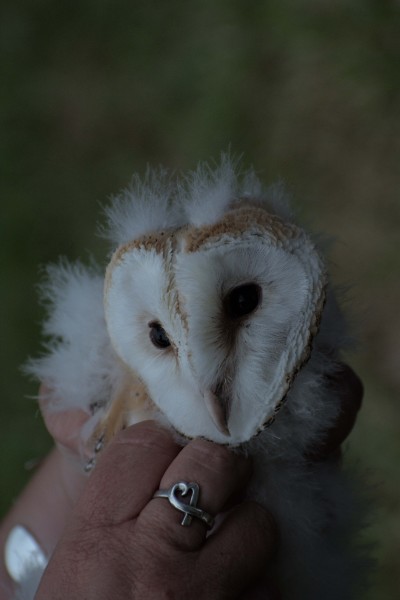 A juvenile barn owl (birds were handled and ringed by BTO-licenced ringers)
The model created by Kavisha can calculate the number of owls in the vicinity by being able to distinguish their individual calls. The distinctions in sounds made by each baby owl would be indistinguishable to the human ear, but the technology is able to pick out the differences in frequency and indicate the number of birds, as well as each individual bird’s indentity.
Although it is still in the early stages of development, testing has been very encouraging and it has successfully identified three baby owls using an audio recording collected from a nest box in North Dorset.
“This basic data is important for monitoring breeding success of barn owls, which can vary greatly between years and breeding sites,” Brian explained. “The AI model is also a great research tool to study the behaviour of young owls and the purpose of their hissing, which is believed to be a means to negotiate who will get fed at the next food delivery by their parents. There may also be potential for the hissing analyses to determine how hungry the owlets are, which again is important data for monitoring breeding success,” he added.
The longer-term aim of the project is to develop the technology so that volunteers and conservationists can take their audio recorders out into nature to capture the sounds of hissing owlets at their nests. Barn owl hissing is loud, so recorders can be placed away from nests to avoid disturbance. The model would then be able to determine how many owls are in the nest, and possibly how old they are.
Strict protocols apply, as barn owls and their nests are protected under Schedule One of the Wildlife and Countryside Act.
“It has great potential for citizen science as it doesn’t require expensive and specialist equipment - anyone could gather recordings and send them for analysis,” Kavisha said. “By making barn owl nest monitoring more scalable and less invasive, we hope this project can contribute to better long-term outcomes for the species. Bringing AI and ecology together in such a positive way is a great example of how this technology can be used for good,” he added.
To learn more about Kavisha's work, you can email him at: [email protected]