Medieval and Iron-Age treasures discovered by Bournemouth University (BU) archaeologists are being showcased for the first time at a new exhibition celebrating some of the UK’s most famous objects and artefacts from history at Dorset Museum & Art Gallery this summer.
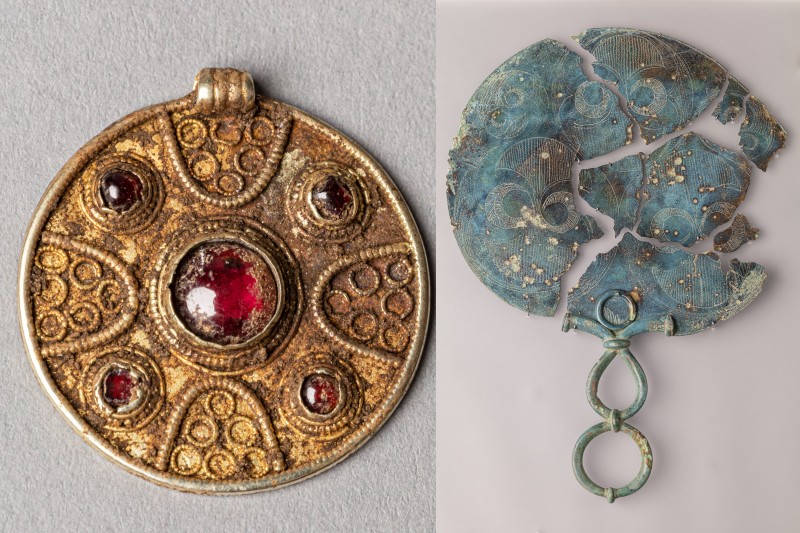
The BU archaeological artefacts being showcased include a first glimpse of a crucifix motif brooch dating from the 7th century in what archaeologists believe could be from one of the earliest Christian burials in Dorset. The finds are from a Charminster burial, an early Medieval (Anglo Saxon period) woman who was buried with some very fine jewellery. This is the first time visitors will be able to see the brooch in public.
BU’s Associate Professor in Forensic and Biological Anthropology, Martin Smith, who worked on analysing the burials said: “In both cases these are the burials of young women who clearly held positions of high status in their respective societies and whose identities would likely have been known more widely than the region of Dorset. Whilst the Langton Herring burial underlines the position of women as apparently holding positions of power in the late Iron Age, the Charminster burial represents a female individual at the forefront of social change as Christianity made new headway into the southwest of Britain.”

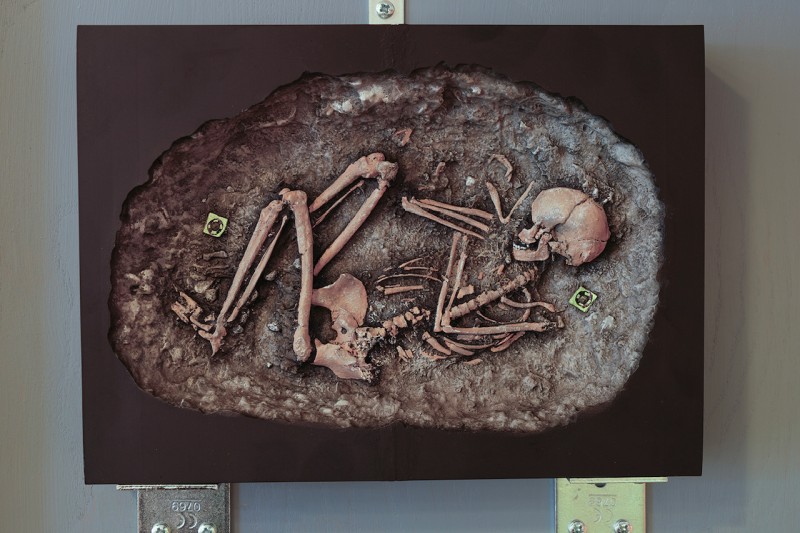
The second object on display at the museum, identified by BU archaeologists, is a decorative mirror from a well-furnished, Late Iron Age Durotrigian burial that was found in 2010 by a metal-detectorist at Langton Herring in Dorset. The copper alloy mirror is extremely rare and was recovered alongside glass and stone beads, a copper alloy arm ring and a Roman coin used as a necklace charm. Archaeologists were able to determine the skeletal remains belonged to a female aged 19-24. The artefacts acquired from this burial are believed to come from diverse sources, deposited at a time of major cultural and societal change in southern Britain.
Martin Smith said: “Although the mirror is a particularly rare and unique object, it’s important to consider all the artefacts that were found in the burial of this young female. These objects remind us that this lady protected and cherished them in life as well as in death. The continental origin of the glass beads and the Roman coin confirm not only a developing interest in bodily modification and adornment in the later Iron Age but also hint at economic and political links between the tribe and societies beyond central southern England.”

The exhibition will bring local objects and significant finds loaned from other museum collections around the Uk together. They will tell the discovery stories of all the objects on display, explaining how they enhance our understanding of the past.
Claire Dixon, Executive Director of Dorset Museum said: “Dorset Museum & Art Gallery has been actively acquiring Treasure since its early origins, and we are excited to be displaying so many of our internationally significant artefacts, many of which have never been seen before. We look forward to sharing them with our audiences, both during the exhibition and afterwards, when they will be incorporated into our displays.”
The show will have four distinct sections. The first explores how ancient objects ended up in the ground, such as grave goods or being lost due to violent historical or natural events. The second will focus on how these objects were brought to light, either through archaeological excavation or metal detecting. Visitors will also be able to explore how the definition of ‘treasure’ has changed through time.
The exhibition will be held at Dorset Museum & Art Gallery from 13 June to 13 September 2026.
For further information about course in Archaeology, please visit the BU website.